Faith
The Dignity of Work
What Silicon Valley Gets Wrong About What Makes Us Human
Elon Musk said the quiet part out loud.
In 2024, describing a future shaped by artificial intelligence, he offered what he called the "benign scenario": "Probably none of us will have a job. There would be universal high income. There would be no shortage of goods and services."
Then he paused — and asked the real question: "If a computer can do, and the robots can do, everything better than you, does your life have meaning?"
He's right to ask it. He's wrong about the answer.
The answer the tech elite keeps proposing is money. Universal Basic Income. Monthly checks. Ownership shares in AI-generated wealth. The framing goes like this: AI will do all the hard, tedious, mind-numbing work that humans were never meant to do anyway, and we'll be free — finally free — to create, to explore, to live. Sam Altman envisions what he calls "universal extreme wealth," a kind of AI dividend for everyone. The vision is sold with the enthusiasm of people who have never had to wonder if their life has meaning, because their net worth settled that question long ago.
They've diagnosed the right problem. They've prescribed the wrong cure. And somewhere in that gap, tens of millions of human lives hang in the balance.
Work Is Not a Punishment
The first thing to get straight is the origin story — because we've been telling it wrong.
Most people operate with a subconscious theology of work: that it's a curse, a consequence, something we do because we have to. The implication is that if we didn't have to, we wouldn't. And from that faulty premise, the logic of UBI and AI-powered leisure seems almost compassionate. Why would we inflict work on people if we had the choice?
But that's not the story Genesis tells.
Before the fall, before the curse, before anything went wrong — God put Adam in the garden to work it and take care of it (Genesis 2:15). Work was not introduced as punishment. It was the original human calling. The tending, the cultivating, the naming of creatures — this was Adam's vocation, given in a state of uncorrupted wholeness, before sin entered the picture.
What the fall changed was not work itself. It was the character of work. "Through painful toil you will eat food from it all the days of your life... by the sweat of your brow you will eat your bread" (Genesis 3:17–19). The thorns came with the curse. The toil, the resistance, the struggle — that's the consequence. But work? Work was already there.
This distinction is not a theological technicality. It changes everything about how we understand the current moment.
If work is the curse, then automating it is liberation. But if work is a divinely ordained expression of what it means to bear the image of a Creator God — if it is how we contribute, build, serve, and participate in sustaining the world — then removing it isn't liberation. It's destruction — a quiet, well-funded, well-intentioned dismantling of the very thing that makes us human.
God himself worked for six days and rested on the seventh. He didn't rest because he was tired. He reflected on what he had made and called it good. There is something being revealed in that — a God who works, and who made creatures in his image to work alongside him in the ongoing care of creation.
"Whatever you do, work at it with all your heart, as working for the Lord, not for human masters" (Colossians 3:23). The dignity of work, in the biblical imagination, isn't derived from what the work produces economically. It's derived from who you are when you do it, and for whom.
What We Already Know About Idle Men
We don't have to speculate about what a world of enforced leisure looks like. We already have a preview.
The Bureau of Labor Statistics reports that over seven million prime-age men — between 25 and 54 — are currently neither working nor looking for work. The labor force participation rate for men in that age range fell from 97.1% in 1960 to 88.6% in 2022, a slide that has continued since. Among 16-to-24-year-olds, approximately 16% are classified as NEETs: Not in Education, Employment, or Training. That's over five million young adults adrift.
Meanwhile, depression among adults under 30 has nearly doubled since 2017, from 13% to over 26% — according to Gallup's most recent tracking data.
These numbers don't describe men who lost a job and are struggling to find their footing. They describe a growing population of people who have, for various reasons, exited the whole enterprise. And what researchers consistently find in that population is not contentment. Not creativity. Not flourishing. They find social isolation, substance use, skill atrophy, and a deep, corrosive purposelessness.
This is not a partisan observation. Marc Andreessen — not a theologian, not a conservative commentator — put it plainly: "Universal Basic Income would turn people into zoo animals to be farmed by the state. Man was not meant to be farmed; man was meant to be useful, to be productive, to be proud."
He's right about the diagnosis. The question is why. What is it about work that, when removed, leaves such a recognizable shape of emptiness in its place?
The tech utopia answers: not enough money yet. Give them more. Make it more comfortable.
I'd argue that's the least interesting thing work gives us — and the easiest to replace. The hard things to replace are contribution, competence, connection, and the felt sense that you are doing something that matters. Those aren't amenities. They're architecture. They're load-bearing walls in a human life, and you don't remove load-bearing walls.
A 90s Sitcom Understood This Better Than Most Economists Do
Here's the moment I keep coming back to.
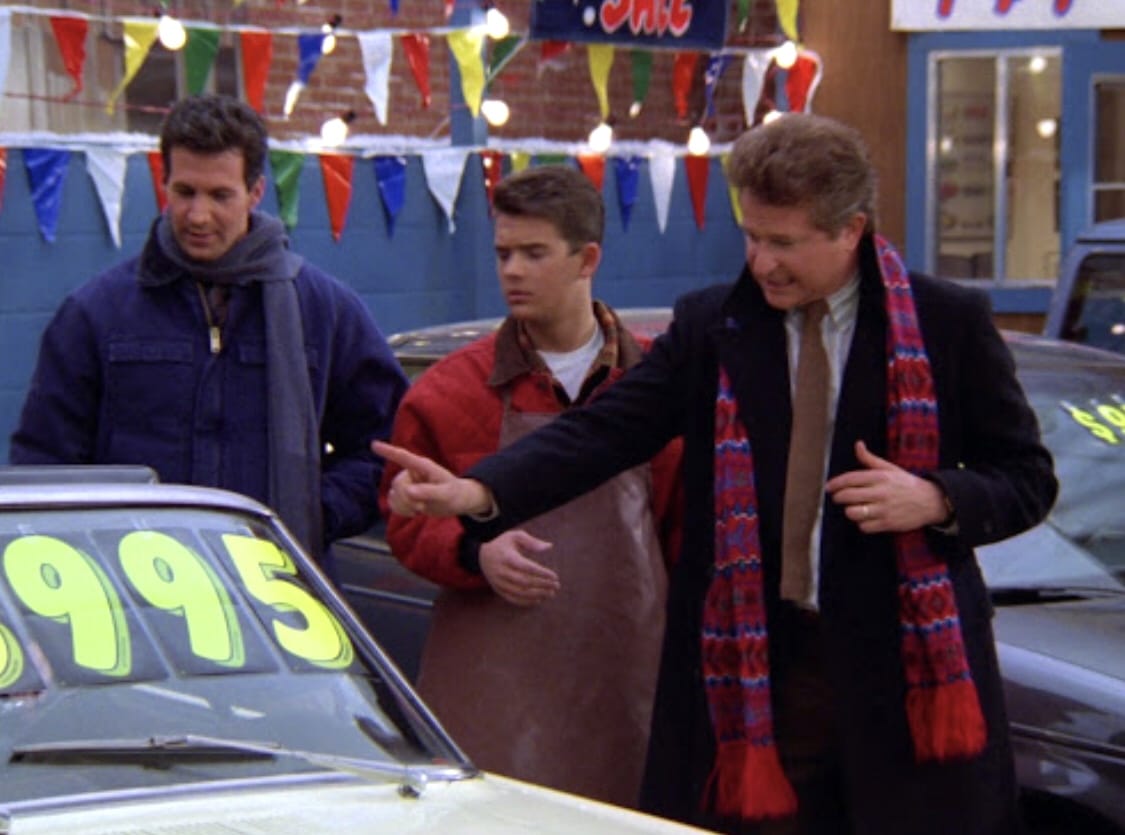
Season 3, Episode 19 of Step by Step is titled "Birth of a Salesman" — a deliberate nod to Arthur Miller. JT Lambert, Frank's teenage son and not exactly an academic standout, is given an ultimatum: get a job or go to college. He gets a job washing cars at a used lot.
Then something happens. A customer starts nosing around a vehicle JT has been detailing. JT — because he loves cars, because he knows them, because he's genuinely engaged — starts talking. Honestly. Enthusiastically. He points out the original interior, the custom kit, the good value even factoring in the brakes that need work. The man buys the car. Not because he was sold to. Because JT cared.
The lot owner comes out and hands JT three hundred-dollar bills.
Three of them. A commission he didn't even know was coming.
JT stares at the money. This kid came in to wash cars for $5 an hour — and he was happy about it. Not settling. Happy. Because a job meant he was doing something, contributing something, showing up to something. That small dignity was already real to him before the first dollar hit his hand.
And now here's $300. Probably the most money he'd ever held at one time in his life. His mind breaks a little. Why would he go to college? Why would anyone go to college? He just sold a car. He just did something. And somebody handed him proof that it mattered.
Later, Carol — the academic-track stepmom — comes down to confront him and drag him back toward school. She watches him close another sale with an older woman who came in skeptical and left with keys in her hand.
Then the lot owner pulls Carol aside — before she can get to JT, before she can say a word. He tells her he wishes his own son had what JT has. His son went to a four-year university. Sixty thousand dollars. Four years. And now he's at the mall with a sour cream gun. The owner says it with a dry, tired smile — maybe he'll work his way up to the guacamole.
Carol came down to set JT straight. Instead she's standing in a used car lot watching her assumptions get quietly dismantled by a man who already paid full price for the lesson she was about to repeat.
Then JT, before she can say a word, thanks her. Not for the money. Not for the car lot. He thanks her for getting him off his keister, because working taught him something he couldn't learn any other way: that he was actually capable. That he had something to offer. That he wasn't a loser after all.
"I thought I wasn't smart enough. I didn't have any abilities. But now I know I can do things. I'm helping people. It's fun. And I'm making money."
In that order. Helping people. Having fun. Making money. The hierarchy matters.
He ends up wanting to go to school — but now it's specific. Business classes. Math with dollar signs in front of the numbers. A direction that came from doing, not from a guidance counselor telling him what the path was supposed to look like.
A 30-minute sitcom from 1994 understood something that a trillion-dollar AI industry keeps missing: work doesn't just fill time or generate income. Work forms people. It tells us who we are and what we're capable of. It gives us a place in the world that no check, however large, can substitute for.
The Crisis of Meaning Is Not Coming. It's Here.
What's being proposed isn't a distant hypothetical. The accelerating displacement of human work by AI is happening now — and the meaning crisis isn't trailing behind it. It's running parallel.
When the work goes, something else goes with it. The quiet conversation across a counter. The satisfaction of finishing something hard. The identity that comes from being someone who does something well. The community that forms around shared labor. None of this makes it onto a balance sheet. None of it factors into an economic model that measures output rather than personhood.
The vision of AI as humanity's liberator from work contains a category error at its core: it treats economic output as the primary thing work produces, when in fact the primary thing work produces is people. Formed, purposeful, contributing, dignified people.
Eliminating that process doesn't free human beings. It unmoors them.
"There is nothing better for a person than to enjoy their work, because that is their lot" (Ecclesiastes 3:22). The Preacher wasn't celebrating workaholism. He was observing something true about how humans are made: we are, at our best, creatures who make things, tend things, fix things, serve people — and find meaning in the doing.
AI should amplify that capacity, not replace it. The question worth asking isn't "how do we free humans from work?" It's "how do we restore work to its proper dignity?" — how do we build a relationship to AI that offloads the truly dehumanizing parts of labor while protecting the parts that form us.
That is a harder design problem. It's also the right one.
A Confession from the Inside
I didn't always see it this way.
For most of my working life, I thought I had a money problem. I thought I resisted work because it didn't pay enough, because I'd been dealt a bad hand, because the system was rigged. I watched people around me grind through jobs they hated, and I concluded that work was the enemy.
That conclusion cost me years.
What I actually had was a theology problem. I had absorbed the idea — from culture, from watching the people around me suffer through work — that work was a necessary evil at best and a punishment at worst. The goal was to need less of it. To escape it. To find the life that existed on the other side of it.
But when I finally understood that work was designed, by God, as an act of participation — as expression, as contribution, as one of the primary ways we bear his image in a world that needs tending — something shifted. Not the work. Me. My relationship to it. The framework through which I understood what I was doing when I showed up and gave something my effort.
The AI industry is, right now, building that same broken theology into the architecture of the future at civilizational scale. I recognize it because I lived it. And I know what it costs.
Work is not the problem.
It never was.
The problem is a world that stripped work of its dignity — that reduced it to economic output, that treated it as a means to an end, that built systems where humans fight for scraps and call that a labor market. That is what needs to change.
The answer is not to remove work from human life. The answer is to restore it to its rightful place — as calling, as craft, as service, as the thing you do, with your whole heart, as if Someone is watching who actually cares how well you do it.
Because he is.
Brandon Ward is building at the intersection of AI, theology, and human identity. He writes from inside the AI evaluation industry, where the questions of what machines can do — and what only humans should — are not theoretical.